Sunday, October 21, 2012


Goa is a slice of tourist heaven, an accessible escape from the smog, stress and searing discord of Pune. A former Portuguese and later Dutch colony, it hugs miles of west India’s coastline as if searching for the escape it offers its Russian, Australian, Swedish, and American guests. Palms trees are generously spread along it’s landscape, sharing space with rice fields, sand, and the occasional church - a interesting change from dominance of the temples elsewhere in India. The sun is an insistent charmer, and if you are not careful, it can make your skin painfully blush for days on end. 
Portuguese Ingreja (Church)

The two brief days we spend there were marked by a haze induced by sleep exhaustion from 10 hours on an unsleepable sleeper bus - a vehicle make you feels like you are a ragdoll as it throws your body up, down, left, right - and giddiness at having arrived at India’s Ocean City. After grabbing some deliciously safe fresh fruit and oatmeal for breakfast, we changed and walked over to the dazzling Arabian Sea. This is where began to Goa showed some of its less appealing nature, however. The ratio of men to women on the beach was about 7-1 and many of the former are looking to ‘click,’ or take a photo of young female tourists. Getting past this awkward speed-bump is challenging, but not altogether impossible if you are in the right company.
That evening we went to an absolutely gorgeous open-air restaurant right near out hotel. Fiesta in Baga Beach is all elegance and finesse, with details that keep you continuously entertained and engaged by its beauty. We ate under the canopy of coconut trees, sitting in dugout canoes filled with soft scarlet pillows. Each bite of food and sip of wine teased my senses and they in turn begged me to stay. The whole experience was exquisite and surprisingly affordable. 
We spent the next day wandering around, shopping at the small stalls along the road, and relishing in the gastronomy (highly recommend: Lila’s Cafe and Infantaria) and the simple pleasure of being able to dress according to climate rather than culture. 
The sleeper bus back was equally as ‘exciting,’ as the one there. We arrived soon enough at 6 am, giving us just enough time to come home, shower, and prepare for another week of classes, coursework, and internship preparation.


On Wednesday my parents, my brother, my sister-in-law and my nephew came to visit. Having the small delegation here, only a fraction of my family if you can believe it, was a surreal experience. I was especially excited to finally meeting my nephew Vivaan. It is always a funny feeling when you introduce close acquaintances to the pieces of your life you have come to know apart from them. It was with this mindset that I showed them around Fergusson College, the Japanese Tea Garden, Laxmi Road and the Ganpati Temple. We also went to Koregean Park for lunch at a Middle Eastern/India restaurant at ABC farms adorned in the likes of a tree house.  The next day I went to class and then met up with them to go to the Kelkar Museum, a private art collection that includes century old artwork, wooden and marble statues of Hindu gods and goddesses, massive dowry chests, and colorfully decorated palanquins. My nephew certainly enjoyed running around the building as he tried to catch daddy and aunty (me!). We went to a traditional Maharastrian restaurant on Tilak road for lunch, a veritable hole in the wall that served all you can chapattis, rice, dal, and other local dishes eat for less than 70 rupees a person. After we finished, Vivaan was getting restless him and his parents headed back to their hotel while my parents and I caught up over had ice cream at Shaviree. 

Wooden Vishnu

Old School Durga

That afternoon I visited my first slum in Pune to conduct some preliminary research for my internship. My interpreter and I were greeted into a remarkably small room as we waited for the micro-finance orientation meeting to begin. During the small pocket of time I was entertained by a one-and-a-half year old girl, dressed up in a delightfully bright green dress. She engaged me a game of peekaboo and my efforts at entertaining her were occasionally rewarded by a soft giggle or a shy smile from her mother. The time passed quickly and the room filled with women and a couple of men. The former were welcomed to sit on a thin cloth on the floor, while the latter took their place on the benches behind. The ratio of the former to the latter was about 3-1, indicative of the demographics of the loans that are usually paid out. As the lecture began, the Marathi and heat began to seriously jeopardized my focus so that I had to constatle move around to try and stay awake. Around 4 pm we caught a rickshaw back so I could go play with Hindi devanagri letters.
After class, I took a rickshaw to my family’s hotel and had dinner at the all vegetarian Italian restaurant right behind their quarters. The mouthwatering display of desserts as we walked in along with three pages of fresh salads in the menu were accurate harbingers of feast that we were to have. Halfway through dinner, courtesy of my brother Frank and his wife Isha, we took a break and were all treated to an impromptu magic show in the hotel lobby. The three men’s antics had impressed them earlier that day and my brother cajoled the hotel to let them in to perform. The main magician, a reedy man of roughly 50 with a grin that revealed a line of blackened lowered teeth, used over 10 languages including German, Kenyan, and French. By the time he was done with his final act, an impressive levitation of his fellow magician, we were dizzy and daft from charade.

Family at dinner

Italian Indian Dinner

Amidst all these occurrences, Pune has been bubbling with festivities yet again, this time in honor of the goddess Durga who is an embodiment of feminine energy or shakti. I cannot help but note that the goddess’ image has become more demure in modern depictions. Durga the fierce warrior goddess riding an equally ferocious mount, a snarling tiger, is mostly absent; the idols at the mandals show an elegant figure wrapped in a becoming sari. This could perhaps be an indication of a change in preferences, marketing, culture or a mixture of all three. Somehow I cannot see the same happening to Kali, however. Feminists around the world would surely be outraged. 
To celebrate the holiday, there have been garbas around the city. A garba is a Gujarati tradition. It involves hundreds of people gathering to dance in dazzling costumes. The high of twirling, swinging, and twisting my limbs in sync with those of dozens of welcoming strangers made me feel like I was accessing the culture in a way that words often prevent. It was liberating to be able to rely on steady, meaningful glances and hearty grins as complete means of communication.

Dancing in the Moonlight


Garba Dancers

On Sunday we were invited over to Priya Tai’s house for an aarti and dinner. A parade of girls from the program wandered into the apartment, each one dressed to the nines in embroidered kurtis, tailored salwar kameezs, and tastefully patterned saris. After we mingled, gushed over each other, and the ceremony was performed the gracefully hosts - Priya, Abouli, Amy, and Hannah- invited us to not just eat, but consume. A coma inducing brunch four-hour brunch earlier that day had my body begging for a rest from everything eatable, but the family insisted I try the carefully prepared homemade gulab jamun, sirope soaked fried balls of sin, and idli sambar. Unable, and admittedly somewhat unwilling to resist, I gave in. Sometimes you just have to bite the bait for pleasure and propriety’s sake.

Bonus: Flower Market and Fresh Idli for Breakfast with Swapna Tai


Idlii Chatani


Thursday, October 11, 2012


Developmentphile: Internship Placement and a Revealing Tribal Visit

Last Thursday, after many weeks of anticipation, we finally found out our internship placements. I will be working at the Parvati Self-Employment Group (PSW), a decade old non-profit in Pune. According to the information provided, PSW works primarily to provide micro-finance, micro-insurance, and vocational training to the “poorest of the poor,” to improve their social and economic mobility in India.
As requested, I will be heavily involved in fieldwork which means, hopefully, that I will be going out to Pune’s slums to gather information on how the organization works. Overall, my responsibilities will include observing how business training and financial literacy programs work, and perhaps most importantly, asking PSW’s clients about the non-profit’s products and their utility. Finally, I will be submitting a report on areas where there is room for improvement. 
Although I won’t be starting full time until after Diwali, so towards the end of November, I was scheduled to go visit the organization today. Waking up, my excitement was matched by my exhaustion so when I was told that the point of contact at PSW could not follow through, I was immensely relieved. Don’t get me wrong, I honestly cannot wait. Just like I came to India to be challenged, I chose the Alliance program because I wanted to learn more about how things work from the bottom up. But I did get some experience in this area just couple of days ago. 

This past weekend I went to the small rural village of Jawahar, Chavi just north of Mumbai. Prof. Apte, the Public Health instructor on my study abroad program, has strong ties to the community from having spent two years living in a nearby the village. A middle age Indian man with a reliable habit of chewing paan or tabacco, Prof. Apte’s familiarity with the region provided the group with the rare chance to observe the state of affairs of tribal people in the country. 
On the second day there, I visited a local family’s farm and a primary public health center that caters to the roughly 35,000 people. During the the first part of the day, my breezy salwar kameez kept me cool as I paced around the manicured plantation that provided sustenance for a family of five. The family that owned the land has been working with an non-profit in three-year program to increase production, stability, quality, and size of their produce. Or as my Development Economics Professor would say, they have steadily been working on improving their products to reaps more profit. See below:

Jasmin Shrubs and Cashew Trees, Indian cash crops

Worm Composting, to make organic pesticide

Rice Field

After lunch we headed over to the medical center. The physician responsible for the facility’s management was a man of no more than 35 years. Our professors explained that the he has a five-month-year-old son he had never met because his dedication to his work. The doctor, whose foreign name has now completely escaped me, followed us around as the Prof. Apte gave us a tour.  The small building stored a meticulously kept inventory of medications readily lined up to tackle venomous snake bites and chronic asthma. Its walls were a museum of candid photos for the illiterate. After wandering around the walls draped with government posters and foreign script, we were led into a room and told that we could ask the physician  some questions about the state of public health services in India. After a few questions about the protocol for disbursing medication, I inquired into mental health. Although I was uncertain about the response the open question would garner, I was completely unprepared for the exchange that followed.

“For over thirty years we have had a bill that states we must address mental illness in India, but currently there is no allocation of funds for mental health at this center,” he explained. Perhaps it was my startled expression that prompted him to add, “We have never had a consoler providing those type of services at our center.” But why not, I asked. Was mental instability not only a prevalent but pervasive problem for the tribals? Almost defensive, the Public Health professor, jumped in. “In India, we are struggling with HIV/AIDs, infant mortality due to lack of access to water, diabetes, and so many other conditions. We simply cannot allocate resources to address mental health.”

The doctors’ explanations touched on a disturbing truth: mental health is not a priority in the rural areas of India. I was shocked at the time, but not entirely surprised. Yes, I know. I must place this experience in context of my sparse knowledge I have about India, but still. I continue to be as perplexed now as I was then. Considering everything I have heard about the government’s commitment to social uplifting, do India’s leaders believe the was a way to develop the population without addressing their mental stability? Do they care enough to allocate resources? Do they care at all?
After some customary research on the subject, I have come to the conclusion, however hasty, that the current state of mental illness in India is most likely due to a trifecta of domestic and international factors. Internally, the primary obstacle is the widespread taboo that surrounds mental illness and the lack of political incentives to address it. Internationally, there is a lack of serious and cohesive commitment to improvement; the lauded Millenium Development Goals, for example, have no reference at all to mental health targets. Some more recent articles did show that India has began to take up the subject, but the tardiness is....well, I guess that’s development right?

On the last day we were split into groups and given a tour of one of the houses in the tribal village. Below are some snapshots:
A Casual Guest, filling a casual vacancy at the back of the house

The Last Cucumber in the Harvest, saved to use its seeds for the next crop
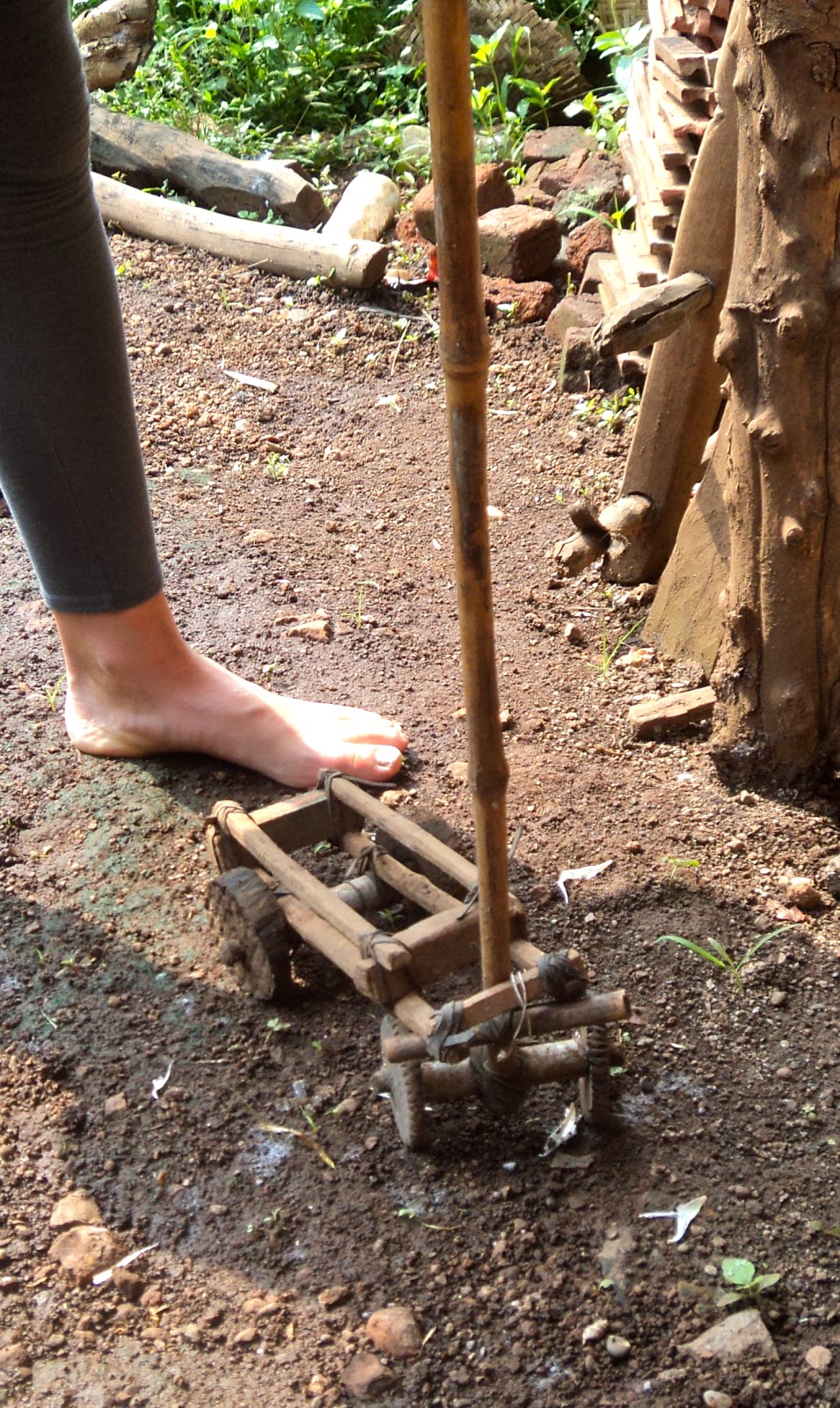
A Toy Car, made by the hands of a boy of 12 years with a bright future in engineering 


Each House Had Pumpkins Growing on its Roof, guess they are gearing up for Halloween?


On a more cheery note, have I mentioned that I am taking the violin? In short, Alliance offers ‘Cultural Expression’ classes that range from traditional dancing to playing the sitar. After a failed attempt at Indian art, I decided to learn to play the violin. With Swapna Tai. Yes, the convenient location is a plus. But Swapna is also a fabulous teacher, a role that involves not only having the patience to help me sound out the notes, but also refraining from how telling me how terrible I am at it. I’m making progress at my sa, re, ga, ma’s. Interestingly, I have also been singing more....

So enough rambling for now. I’m off to Goa tomorrow. I promise to collect stories about the Indian beaches and the not-so-Indian beach bums. :)

Saturday, September 29, 2012


Encounters with the F word I left behind in Durshet,* but insisted on crawling back

The past week has been heavy. Last Sunday I came back from a weekend in Hyderabad, another IT hub located in Andrha Pradesh. The two days Amy, HGM, and I spend there were a much needed break from Pune. Among the glowing-white marble carvings of the Birla temple and the naked foundations of Goldkonda Fort, the honeymoon feelings of the first couple of days playfully tugged at me. India was apologizing for soaking my lungs in tar and willfully dissolving my patience. Either that, or it was doing a damn good job at behaving for once. Pune, like a rebel limb, has so far remained reticent. It welcomed us back in a minivan whose door kept snapping open like the mouth of a petulant child.

Now roughly a month into the program, I can say with absolute conviction that Pune is consistently and aggressively confusing. Visually, it is a disjointed collection of outdated infrastructure and poor city planing. Psychologically, it is just as incongruent. Simple errands, such as getting toilet paper or going to the post-office, are highly time-consuming. There is also little flexibility: making suggestions is usually either irrelevant, impossible, or detrimental. Pune will be Pune, even if you ask it nicely to behave for a moment. Granted, coming straight from D.C., the challenges of living here were going to be [word here not currently available in English vocabulary. In Spanish: bien hijo de puta]. Yet they have not so much snuck up on me as they have pugnaciously stared me down.

So yes, unsurprisingly studying abroad in India does not mean being enveloped in rich spices so much as it does drifting along in a thick haze of smog and, here comes the f-word, frustration. On the other hand, reaching the outer bounds of my sanity so frequently seems to have actually extended their length. So that just as I think I am going stepping off some mental cliff, I find myself taking another step forward instead.

Overall, the trying inconsistencies make this place inexplicably alluring as if by investing more, it gets harder to pull away. And the fascination only grows. 

On that note, here are a couple of tokens from the past week:

The Charminar


Mecca Masjid, the Largest Mosque in Hyderabad. No women are allowed inside!


Bangle Shopping in Laad Bazaar!


Golkonda Fort


Biryani, a Hyderabadi Specialty, at Paradise
 Pictures From the Final Day of the Ganapati Festival:
Ganapati Idol
Rangoli, Sand Art on the Road


Third of the Five Main Ganapatis


Ribbon of the Procession Winding its Way Through the Crowds


Flag Dancers


Perspective
Dol Groups


In the Ebullient Throng
Watching the Massive Procession from Afar

*Frustrated, and all of its colorful derivatives


Thursday, September 20, 2012


Festivals and Culture

I could describe all that I have seen, smelled, and felt regarding the culture here, but still pictures would  be necessary show the dances, the drums, the music, and the vibrance of Pune. Below is a selection of photos of the events I have attended in the past week which would be far too difficult and tedious to illustrate with words. 

Last Sunday, we were invited to a neighborhood event where local children and adults alike performed dances to traditional India music in commemoration of Teachers’ Day. It was a lengthily event, running over four hours in duration. The attendees told Swapna Tai that they were very much impressed with out ability to sit quietly for such a extensive period of time. Little did they know that as a missionary’s daughter I have been training for this type of stuff for years.


Older dancer in traditional dress for Bharatanatyam 

String of bells on feet for the dance

Younger girls dancing Bharatanatyam 

Yesterday the highly anticipated Ganesh Festival started. Since then invitations to aartis - worship ceremonies performed each of the 10 days of the festival to honor the God - have been plentiful. So far, I have attended four and the young girls in the neighborhood have assured us that we must come everyday to sprinkle rice on their idols and eat prasad. Not sure if this will be feasible as I can really eat only so much Jalebi, but nevertheless their hospitality and impromptu bollywood dancing has been both entertaining and welcome. 

Mini Ganapati we had out first aarti for
Post aarti at Swapna's in laws, Amy is modeling her breathtaking sari


One of the larger shrines that have sprouted up around Pune


Ganesh Shrine at another 'mandal,' or group worshiping site.
Another Mandal near Laxmi Road*

Moving Ganapati!*
Artists performing on the streets*


Temporary scaffolding for the festivities


The Crowds
Bonus! Architecture in and around Pune:

 Tulsi Bag
Rama temple in Tulsi Bag
Parvati Hill Temple at 6:00 am

Mundai Landmark
Pune's most expansive greenery
Temple near Parvati Hill before dawn
**Photo credit Lauren Cichock

Saturday, September 15, 2012


Questions: Hindi, Two Wheeler, Waterfall Rappelling, Surprise Birthday

Throughout these past seven days, I have been playing chess with the curves and lines of devanagari -the script in which the local language and Hindi are written. To my surprise and chagrin, I have discovered that the scribbles and sounds have a life of their own. This becomes clear as they flow from my mind to my mouth, out my lips and across the room to finally reach ears of our teacher. The foreign source from which they depart and the journey make the words antsy. As they leave, I can already see rooks of doubt and queens of form challenging them. The pressure to perform becomes too great and they become weak, their courses increasingly unchartered. By the time they land my original meaning has been lost. Instead of inquiring about the market's address I end up with some variation of, 'Is this the market's pen?' Judgement strikes. Checkmate.

Yet on the off-chance that I am able to harness a couple of the shapes, I have learned to ask questions including 'What is this blue lotus?' and 'Is this water?' Being able to inquire as to whether the water is clean or where is the water from, perhaps more pressing questions in a country which strongly encourages pre-visit typhoid shot, remains a distant dream. 

When I am not straining to discipline Hindi script, I have been asking questions of a different sort. Results below:

 In response to, "Can I ride with you on your two-wheeler?" 


This gem-of-an-experience occurred when Swapna took us to see the drum groups. Not all nine of us could stack - yes stack not sit - into her compact car, so I volunteered/demanded/asked to ride with one the girls on Pune’s preferred mode of transport - the two wheeler. After having read Zen and the Art of Motorcycle Maintenance over the summer I was anxious to experience the rapid and liberating movement Pirsig described on every fourth page. It was immensely rewarding and, fingers crossed, will not be my last.


“How safe it it to rappel down this waterfall?”


Last Sunday, a number of us hiked around the unspoiled, emerald city of Dudhivare, Pune to reach a cascading 150 meter stream of water we had signed up to rappel down. Exhausted from waking up at 5:00 am to catch a 6:00 am bus (i.e. 9:00 am India Standard Time - IST), we chatted and explored as each of us waited our turn. Our lungs readily welcomed the pure mountain air, lightly perfumed by blossoms of gardenia. A white temple stood near the center of a panoramic view of a stunning cobalt lake framed by vivid green forests. The sun peeked out around midday, strengthening shadows and boosting the sparkle of the landscape.
At 3:00 pm, I was finally peering down the edge of the waterfall as one of the guides tried to put my mind at ease by explaining in fractured English that all the equipment met international standards. “Just feet keep apart, lean back,” he instructed. I continued to say those words as I set one foot behind the other, balancing all my weight into the harness. About halfway, I looked back and caught a glance of the group, small figures against the gorgeous background. Too soon, a rush of cold water glided over the view and I raced to the bottom. As my feet touched the horizontal rock I could feel the adrenaline begin to ease.

“What are we doing for your birthday?”

HGM celebrated her 21st yesterday. I managed to distract her as Amy, her roommate, and Abouli, her host sister, decorated the house for a surprise dinner of HGM’s favorite - Idli and Saanbar. One our way back to their house, HGM asked if I was coming over for dinner the next day. I assured her I was, turning my face away should she would not spot my smile. At midnight we had cake and the next day we went to Pheonix Mall to eat at McDonald’s as per HGM’s request. Although it is quite far away, the journey was well worth the 170 rupees. For the next couple of hours we explored a slew of Indian and western stores inside the sophisticated complex. HGM enthusiastically noted it was her best 21st birthday ever.